
1.3 Rīchi
We have finally arrived at the section that delivers on the title. In this rīchi mahjong, rīchi is not merely a distinctive mechanic—it is the core mechanism compared to other forms of mahjong. As previously stated, rīchi is a circumstantial yaku that can be used simply by being in tenpai with a closed hand. This not only opens a path for hands without any hand-based yaku to quietly advance while staying closed, but also stacks with hands that already possess hand-based yaku. Moreover, Japanese mahjong has many closed-hand yaku (menzenyaku) that only count for closed-hand wins, causing these yaku to appear more often together with rīchi. This section will introduce the rīchi mechanism and more yaku, but first, TianSalt would like to revisit the topic of points. After all, Japanese mahjong is a game of competing for final rank, and rank is determined by held points. To gain a concrete understanding of how much a hand can score—tactically often called daten—we will first explain scoring above mangan. This part of the calculation is the simplest, and the one that newcomers tend to learn first. Note that this section focuses only on general rules; differences from competitive rules will be covered in the next section.
1.3.1 Mangan
In practice, we will ignore the base points (kihonten) explained in 1.2.1 and look only at the points lookup table. However, in principle, when base points reach 2,000, this is called mangan (limit hand). In classical mahjong, mangan was the absolute ceiling for scoring. Later, with score inflation, the modern mechanism became: when base points exceed 2,000, fu is no longer considered and only han matters—up to 5 han, base points are capped at 2,000, while hands of 6–7 han have base points fixed at 3,000, 8–10 han at 4,000, 11–12 han at 6,000, and so on. As we will learn in the next section, below mangan, each han does literally double the score,[1] but above mangan, the increase slows dramatically. Specifically, the points lookup table for above mangan is as follows:
| Han | Name[2] | Non-dealer win | Dealer win | Rate[3] |
|---|---|---|---|---|
| 70 fu or more, 3 han 40 fu or more, 4 han 5 han | Mangan | 8,000 2,000/4,000 | 12,000 4,000 all | 17.48% |
| 6–7 han | Haneman | 12,000 3,000/6,000 | 18,000 6,000 all | 7.80% |
| 8–10 han | Baiman | 16,000 4,000/8,000 | 24,000 8,000 all | 1.25% |
| 11–12 han | Sanbaiman | 24,000 6,000/12,000 | 36,000 12,000 all | 0.05% |
| 13 han or more | Yakuman | 32,000 8,000/16,000 | 48,000 16,000 all | 0.11% |
Key: Using the mangan row as an example, 8,000: points paid by the dealing-in player when a non-dealer wins by discard; 2,000/4,000: points paid by the non-dealer and dealer respectively when a non-dealer wins by self-draw; 12,000: points paid by the dealing-in player when the dealer wins by discard; 4,000: points paid by each non-dealer when the dealer wins by self-draw.
Yakuman can be considered the upper limit of scoring in modern Japanese mahjong. Completing rare yaku such as Big Three Dragon, Four Concealed Triplets, or Thirteen Orphans immediately counts as yakuman; at this point, all non-yakuman yaku are completely ignored, and base points are taken directly as 8,000 (detailed in the next section). Reaching 13 han or more through accumulation of regular yaku is called kazoe yakuman (“counted yakuman”).
The way points are displayed in the lookup table is also how the winning player declares their points. For example, a dealer mangan[4] win by discard is declared 12,000; a dealer mangan win by self-draw is declared 4,000 all; a non-dealer haneman win by self-draw is declared 3,000/6,000. If there are honba, append wa and then declare the total points including honba payments; for example, at Honba 1: 12,000 wa 12,300, 4,000 all wa 4,100 all, 3,000/6,000 wa 3,100/6,100.
Following the pattern that dealer points are 1.5× non-dealer points, gradually memorize this table.
1. Points Calculation
South 1, Honba 2, South Player
00004p1z000000 2m2m3m4m5m1p2p3p4p0p 2z2z2z-2z= 3p Ron
8 han (Double-South, 6 dora)
Baiman, 16,000 wa 16,600
1.3.2 Rīchi
Rīchi (also written “reach,” though this is not its etymological origin) is the most distinctive mechanic in Japanese mahjong. When in tenpai with a closed hand (menzen), you can declare rīchi. Specifically, after any draw, if the following conditions are simultaneously met:
- Closed hand (no chī, pon, or open kan).
- Already in tenpai.
- Held points are at least 1,000 (if the rules allow bankruptcy).
- At least 4 tiles remain drawable from the wall (competitive rules do not impose this limit, i.e., “rīchi with no remaining turns” is permitted; however, you cannot declare rīchi after drawing the haiteihai).
You may:
- Announce “rīchi.”
- Discard the tile that puts you in tenpai, placing it sideways in your discard pile; this is called the rīchi declaration tile (rīchi sengenpai) (if this tile is called by another player, your next discard is also placed sideways; if another player wins on it, skip step 3).
- Pay one 1,000 stick as kyōtaku (“deposit”), placing it in the center of the table; this is called the rīchi stick (rīchibō).
- Maintain a closed hand; until the end of this hand, you cannot choose which tile to discard and must discard whatever you draw (tsumogiri[5]).
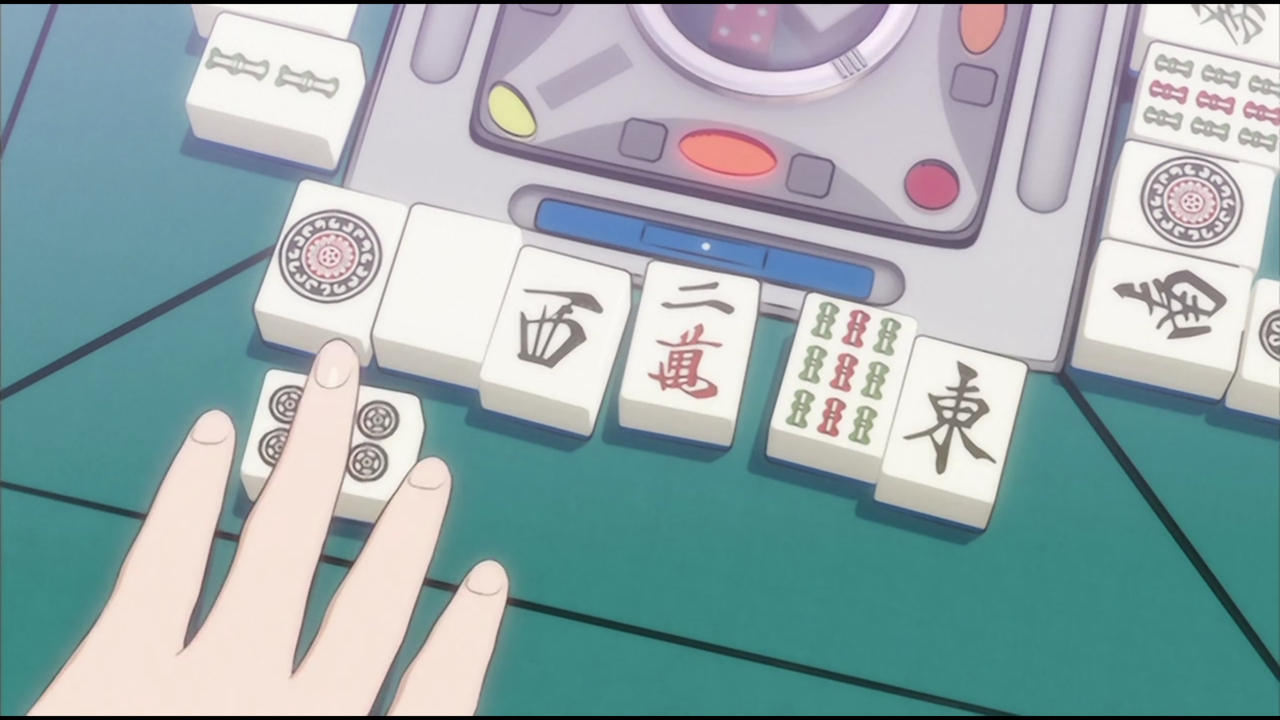
Every player can declare rīchi; all kyōtaku belongs to the winner of that hand. If the hand ends in an exhaustive draw, kyōtaku continues to accumulate until a winner appears, who then takes all kyōtaku from this and previous hands. If exhaustive draws continue until the end of the match, kyōtaku goes to the top player.
Winning after declaring rīchi constitutes a yaku by itself, and is the highest-frequency yaku in Japanese mahjong:
立直 : Winning after declaring rīchi in that hand. Worth 1 han. When combined with tanyao etc., it is often abbreviated as men, e.g., rīchi + tanyao is abbreviated as mentan.
Beyond the 1 han, rīchi has two additional potential benefits. The first is the coincidental yaku with the highest frequency:[6]
一発 (One-Shot): Winning within one turn after declaring rīchi. Adds 1 han.
That is, winning by discard (ron) before your next draw after declaring rīchi, or winning by self-draw (tsumo) on your next draw. It must be noted that within one turn here requires that no chī, pon, or kan (including closed kan) occurs during that interval. The same applies to double rīchi and chīhō discussed later.[7]
The second benefit is that only rīchi declarants have the right to flip uradora (“hidden dora”) indicator tiles. The dora indicator tiles explained in the previous section are all in the upper row; to distinguish them, they are collectively called omotedora (“surface dora”) indicator tiles. Uradora indicator tiles are the tiles directly below the corresponding omotedora indicator tiles; they are revealed only when a rīchi declarant wins, and are effective only for rīchi declarants. Uradora indicator tiles also increase as kan declarations increase on the table, but only the lower tiles of already-revealed upper indicator tiles are effective; newly added uradora from kan are also called kan’uradora. When counting han, omotedora can be called dora, while red dora and uradora are respectively called aka and ura.
Being in tenpai with a closed hand and hand-based yaku, but choosing not to declare rīchi, is called damaten (“silent tenpai”) or simply dama. However, given rīchi’s powerful effectiveness—especially for good-shape tenpai below mangan—declare rīchi immediately upon tenpai (tenpai sokurī) with a closed hand is often the correct play.
There is also another coincidental yaku related to rīchi:
両立直 (Double Rīchi): Declaring rīchi immediately upon your first draw, provided no other player has called any tiles since the start of the hand. Worth 2 han. Does not count rīchi. Abbreviated as daburī.
Fun fact: Historically, the original meaning of rīchi was declaring tenpai on the first turn, somewhat similar to the modern double rīchi.
1.3.3 Furiten
Furiten is a tenpai state where winning by discard is prohibited. There are three triggering conditions:
- Furiten by discard: The primary meaning. If any of the tiles you are waiting for are among your own discards (including tiles called by other players), you remain in furiten until the condition is no longer met (by changing your wait or dropping tenpai). Therefore, every time you reach tenpai, it is best to first check whether you are in furiten and can win by discard, to avoid a foul (chonbo).
- Furiten after rīchi: If you could win after declaring rīchi but pass (minogasu), you enter furiten status until the end of that hand.
- Temporary furiten: If you could win by discard but do not, you enter furiten status until your next discard.
Common situations that cause furiten:
- You previously discarded
1m from1m4m5m , then successively drew3m 6m 2m , ultimately becoming a three-sided wait on1m4m7m —furiten due to having discarded1m . Multi-sided waits easily trigger furiten; pay special attention. However, if the wait is very wide, one may directly choose furiten rīchi, aiming only for a self-draw win. - One side of a multi-sided wait achieves more yaku or even yakuman, so you intentionally pass on the other side’s winning tile.
- You open your hand aiming for tanyao nomi, but end up waiting on
1p4p with2p3p . Constrained by the one-han minimum (īhan shibari), whether you draw1p or another player discards it, you have no valid yaku and cannot win, resulting in furiten. Furiten is judged solely by shape, regardless of yaku. A hand that can only win on one side is called kataagari (“side winning”).
Because dealing in (hōjū) carries a high penalty, Japanese mahjong heavily emphasizes defense. When another player has declared rīchi or is clearly in tenpai, if you are not yet in tenpai or are two or more tiles away, or if your hand’s value is far lower than theirs, it is common to adopt a stance of completely abandoning the win (betaori, or “folding” in English), even breaking up your hand to prevent dealing in. And furiten is precisely the mechanism most often leveraged for defense. The most basic defensive strategy is to play a rīchi declarant’s genbutsu—tiles they have already discarded. Genbutsu are absolute safe tiles (anpai); due to the discard furiten rule, playing another player’s genbutsu can never be won on by discard by that player—we say such a tile “passes” (tōru). The latter two types of furiten can be applied similarly: we can deduce that copying the tile discarded by the player to your left in the same turn will never deal into anyone, and that after one player declares rīchi, all tiles discarded and passed by other players have already passed the rīchi declarant.
1.3.4 More Yaku
In this subsection, we will introduce all remaining non-yakuman yaku. The next section will provide a complete yaku reference table. Beyond yakuhai and tanyao, try to notice scenarios where other hand-based yaku have higher chances of being achieved.
1.3.4.1 One-Han Yaku
搶槓 (Robbing a Quad / Robbing a Kan): When another player makes an added open kan, and you are waiting on exactly that tile, you may call ron. Worth 1 han.
The rarest coincidental (non-yakuman) yaku. Chankan is treated as a special win by discard: the declaration is also ron, points are settled as a win by discard, and intentionally passing also results in furiten. If chankan occurs, that kan is treated as not established: no new dora indicator is revealed, and it does not affect ippatsu.
All coincidental yaku (excluding yakuman) have now been covered: rinshan, haitei, hōtei, ippatsu, daburī, and chankan.
門前清自摸和 (Fully Concealed Hand): Winning by self-draw with a closed hand. Worth 1 han. Also known as menzen tsumo or simply tsumo.
One of the highest-frequency yaku. Aside from chankan and hōtei, which are limited to wins by discard, this yaku can combine with all non-yakuman yaku—be careful not to miss it. There is also tsumo nomi: having no hand-based yaku but staying in damaten, then winning by self-draw. In a closed hand, not only does a self-draw win reward 1 han, but a win by discard also rewards 10 fu (see the next section).
平和 : The hand simultaneously satisfies- No triplets or quads; all four melds are suited sequences.
- The eyes are not yakuhai; that is, they are suited tiles or “off winds”—wind tiles that are neither round winds nor self winds, also known as “guest winds” (otakaze).
- The wait pattern is ryanmen.
Closed-hand yaku; worth 1 han. Combined with tanyao, called pintan; with rīchi, called menpin; with both rīchi and tanyao, called mentanpin. Mentanpin + tsumo + dora is a typical mangan hand.
Pinfu (“common hand”) was a core concept in classical mahjong, referring to a winning hand with no added fu. We will mention this further in the next section’s fu calculation. Later, pinfu became a yaku, and when the īhan shibari became widespread, pinfu was changed to closed-hand only to prevent it from being too easy to achieve.
一盃口 (Pure Double Sequence): Containing two identical sequences. Closed-hand yaku; worth 1 han.
Beginners easily forget that īpēkō is closed-hand only. Since īpēkō is a sequence-based yaku, “1 han, closed-hand only” is essentially the same nature as reduced by 1 han when not closed (see below). In fact, rīchi, tsumo, Seven Pairs, etc., are also closed-hand yaku, but there is no need to particularly note this, so this tutorial does not mention it when introducing them. The only yaku whose closed-hand restriction needs special attention are pinfu, īpēkō, ryanpēkō, and Nine Gates (chūrenpōtō)—just four.
2. Points Calculation
East 2, Honba 0, East Player, *rīchi
Dora 5m , uradora 4z 3m4m4m5m5m4s5s6s6s6s6p7p8p 3m Ron
6 han (rīchi, tanyao, pinfu, īpēkō, 2 dora)
Haneman, 18,000
Winning on
1.3.4.2 Seven Pairs
七対子 (Seven Pairs): Instead of four melds and one pair, having seven distinct pairs also constitutes a winning hand. Worth 2 han. Abbreviated as chītoi.
Among hand-based yaku, it can combine with tanyao, Full Flush, Half Flush, and All Terminals & Honors. To distinguish them, the four-melds-one-pair shape is called a mentsute (“meld-based hand”), and the seven pairs shape is called a toitsute (“pair-based hand”).
1.3.4.3 Sequence-Based Yaku
三色同順 (Mixed Triple Sequence): Each of the three suits contains a sequence of the same numbers. Closed hand 2 han, open hand 1 han. Abbreviated as sanshoku.
This property of reduced han when the hand is open is called kuisagari (“eating and decreasing”), and is very common among sequence-based and flush-based yaku. For example, sanshoku dōjun is generally described as kuisagari 1 han (1 han if the hand is open). The above is a kataagari example.
一気通貫 (Pure Straight): Containing the 123, 456, and 789 sequences of the same suit. Closed hand 2 han, open hand 1 han. Abbreviated as ittsū.
混全帯么九 (Half Outside Hand): Every meld and pair contains a terminal or honor tile, and at least one of them consists of honor tiles. Closed hand 2 han, open hand 1 han.
純全帯么九 (Full Outside Hand): Every meld and pair contains a terminal tile. Closed hand 3 han, open hand 2 han.
二盃口 (Twice Pure Double Sequence): Two sets of īpēkō. Closed-hand yaku; worth 3 han. Does not count īpēkō or Seven Pairs.
3. Points Calculation
East 2, Honba 3, West Player
Dora 3m 1m2m3m3m3m3m2z 1p2p-3p 3s-1s2s 2z Ron
6 han (chanta, sanshoku, 4 dora)
Haneman, 12,000 wa 12,900
1.3.4.4 Flush-Based Yaku
混一色 (Half Flush): Suited tiles are all of one type, plus honor tiles. Closed hand 3 han, open hand 2 han.
清一色 (Full Flush): Composed entirely of suited tiles all of one type. Closed hand 6 han, open hand 5 han.
Flush-based yaku are collectively called somete (“dyeing hand”). In Japanese, a closed-hand Half Flush is called menhon, and a closed-hand Full Flush is called menchin. Here, men does not refer to rīchi. In fact, since hands of 6 han and 7 han have the same scoring value, making a closed-hand Full Flush often involves choosing damaten.
Full Flush is not only elegant, but frequently produces dazzling multi-sided waits, so much so that dedicated strategy guides exist for it.
4. Points Calculation
East 1, Honba 0, South Player, *rīchi, *ippatsu
Dora 5m , uradora 9p 1p1p2p2p3p3p7p7p8p8p9p9p9p 9p Tsumo
20 han (rīchi, ippatsu, tsumo, pinfu, junchan, ryanpēkō, chin’itsu, 4 ura)
Kazoe yakuman, 8,000/16,000
This can be viewed as a
A hand like this—you might win it once in a lifetime, if ever.
1.3.4.5 Triplet-Based Yaku
All triplet-based yaku have no kuisagari. Triplets can all be replaced with quads.
対々和 (All Triplets): All melds are triplets. Worth 2 han. Abbreviated as toitoi.
The most commonly seen triplet-based yaku aside from yakuhai, with an occurrence rate around 2%; other triplet-based yaku are all significantly below 1%. The above is an toitoi + yakuhai example.
三暗刻 (Three Concealed Triplets): Containing three concealed triplets. Worth 2 han.
Can combine with All Triplets. This example demonstrates that a shanpon wait self-draw counts as one concealed triplet. Four Concealed Triplets (sūankō) is a yakuman; see the next section.
小三元 (Little Three Dragons): Containing triplets of two types of dragon tiles and the third type as the eyes. Worth 2 han.
Necessarily includes two yakuhai triplets, resulting in a minimum of 4 han for the hand. Big Three Dragons (daisangen) is a yakuman; see the next section.
混老頭 (All Terminals and Honors): Suited tiles are only terminals, plus honor tiles. Worth 2 han. Does not count chanta.
Necessarily combines with All Triplets or Seven Pairs, resulting in a minimum of 4 han. All Terminals (chinrōtō) is a yakuman; see the next section.
三色同刻 (Triple Triplet): Each of the three suits has a triplet of the same number. Worth 2 han.
Not abbreviated as sanshoku—after all, the occurrence rate is about 1/100 of sanshoku dōjun, even lower than Four Concealed Triplets.
三槓子 (Three Quads): Containing three quads. Worth 2 han.
Legendary tier, with difficulty exceeding common yakuman. Not only is assembling three quads difficult, but declaring kan in Japanese mahjong inherently carries many disadvantages, and there is the restriction that at most four quads can be declared per hand, among other factors. Four Quads (sūkantsu) is a yakuman; see the next section.
5. Points Calculation
South 3, Honba 0, West Player
Dora 5z 3s3s3s7s7s7s8s8s3z3z 1s1s1s- 3z Ron
5 han (West, toitoi, hon’itsu)
Mangan, 8,000
1.3.5 Closed kan After Rīchi
Closed kan after rīchi is permitted, but sometimes restricted; examining the details reveals a rather complex set of rules.
Simply converting a closed triplet to a closed kan with nothing else changing, as above, is permitted. As for situations that are not permitted, let us examine some examples.
Originally a three-sided wait combining the
Making a closed kan of
The above two situations are what is prohibited in Tenhō and Mahjong Soul. However, under competitive rules, any closed kan that involves a change in meld composition is entirely prohibited. Interested readers, please expand below to read more.
These examples are prohibited under competitive rules, though you will rarely encounter them in practice—read for fun if you like.
Originally waiting on
Similar to the above. Originally a three-sided wait of
At first glance, this appears to be a
If the possibility of kan-
This hand can be viewed either as tanyao + Three Concealed Triplets or as tanyao + pinfu + īpēkō. However, making a closed kan completely eliminates the possibility of the latter interpretation.
This final example is permitted under competitive rules, but may be prohibited under traditional rules. Explaining this example requires a spoiler: this is the yakuman Nine Gates (chūrenpōtō). Nine Gates not only requires a closed hand, but also prohibits closed kan. Making a closed kan here eliminates Nine Gates, turning it into an ordinary chin’itsu. Meanwhile, looking closely, to maintain tenpai, you can only interpret this as kan-
See 1.2 Note 2. ↩︎
Mangan literally means “full”; Haneman is “bumping up mangan”; Baiman is “double mangan”; Sanbaiman is “triple mangan”; Yakuman is “yaku mangan.” Under competitive rules, yakuman is also known as yonbaiman (“four-fold mangan”). ↩︎
June 2026 Tenhō South kuitan akahai average data: https://tenhou.net/sc/profmg.html ↩︎
Colloquially called oyaman, and likewise oyappane and oyabai. ↩︎
Conversely, discarding a tile from your hand other than the one just drawn is called tedashi. To distinguish the two, Japanese mahjong generally requires you to complete your discard first, then organize the newly drawn tile into your hand. Using the kotegaeshi technique to quietly mix them up is considered poor etiquette. ↩︎
Source: Tenhō yaku statistics (hanchan basis): https://tenhou.net/sc/prof.html (same below). ↩︎
After another player declares rīchi, intentionally calling tiles regardless of risk to negate ippatsu is called ippatsu keshi (“to eliminate ippatsu”). ↩︎