
1.2 Yaku, Calls, and Rounds
Mahjong has always been a game with countless variations in detailed rules, whether in offline play or on online battle platforms. Therefore, it must be acknowledged that the “general rules” referred to in this tutorial are primarily aligned with two platforms: Tenhō (Official Website), which launched in 2006 and is universally recognized for having the highest level of play and the most prestigious dan rankings, and Mahjong Soul (ZH, JA, and EN Official Websites), which launched in 2018, shares basically identical rules with Tenhō, and stands as the most popular online mahjong platform today. After all, apart from these two, other platforms that were once popular have all been lost in time, like tears in rain. Meanwhile, the “competitive rules” are primarily modeled after the highly popular M.League (Official Website). Although it incorporates akahai and can be seen as a modern competitive rule set that has compromised with widespread parlor rules, we are, after all, a tutorial for the modern era. As for other rule variations that remain fairly common, we will list them separately in a dedicated section.
1.2.1 Points
In any form of mahjong, if a winning hand fulfills certain specific patterns or special conditions in addition to the basic winning shape, it often receives extra rewards. The colloquial idiom 清一色 (MSC: qīngyīsè), commonly heard in everyday Chinese to mean “uniformly,” originally refers to a mahjong winning hand composed entirely of a single suit. Known as a Flush in English, this hand also yields a substantial payout in Japanese mahjong. Besides Flush, there are over thirty other specific winning shapes or special conditions in Japanese mahjong, collectively known as yaku.[1] The value of a yaku is measured in han,[2] and multiple yaku achieved simultaneously can combine, adding their han values together. In Japanese, yaku achieved through specific hand patterns are called teyaku (hand-based yaku), while those achieved by meeting special conditions are called jōkyō (“circumstantial”) yaku. Among the latter, except for menzenchin tsumohō and rīchi, all are literally gūzen (“coincidental”) yaku.
The number of han determines the value of the hand, which in turn determines the points of the winning player. Each player’s points at the end of the match determine their final rank, and the final rank determines their mood. At the start of a match of Japanese mahjong, each player most commonly begins with 25,000 points. A match consists of multiple hands (kyoku, see 1.2.3), and points are calculated and exchanged at the end of each hand. Specifically:
- Non-dealer win by self-draw (tsumo): The dealer (East) pays the winner 2× the base points,[3] while the other two non-dealers each pay 1× the base points, totaling 4× the base points for the winner.
- Non-dealer win by discard (ron): The player who dealt into the winning hand (hōjū) solely pays the winner 4× the base points.
- Dealer win by self-draw (tsumo): The three non-dealers each pay the dealer 2× the base points (totaling 1.5× the payout of a non-dealer win).
- Dealer win by discard (ron): The player who dealt into the hand solely pays the dealer 6× the base points (1.5× the payout of a non-dealer win).
- Exhaustive draw (ryūkyoku, the hand ends with no winner after the wall is drawn): Players who are not in tenpai collectively pay a total penalty of 3,000 points (nōten penalty or nōten bappu), which is then split equally among the players who are in tenpai (see 1.2.5.2 for details).
The scoring of Japanese mahjong, in addition to being heavily influenced by the number of han, also retains the classical fu system. To avoid mental calculations during every hand, players generally memorize a points lookup table, which we will discuss in detail later. For now, let us introduce the chips used in Japanese mahjong to represent a player’s current points—tenbō (“point sticks”):


As the game progresses, players estimate the potential value of their hand to calculate the conditions required for a comeback, and declare their points immediately upon winning. Modern Japanese mahjong enforces a one-han minimum constraint (īhan shibari). If you do not have any yaku, even if you have formed “four melds and one pair,” you will find that there is no “zero han” column in the points lookup table. In this case, declaring a win means you cannot state valid points, which constitutes a foul (chonbo). Therefore, in addition to focusing on the winning shape, we must simultaneously keep an eye on the yaku we need to achieve.
1.2.2 Chī and Pon
To secure at least one yaku, our strategy can be highly simplified into two directions:
- If you have a good prospect of completing any hand-based yaku, you can utilize the naki mechanics introduced in this section to advance your hand.
- If the prospects for any hand-based yaku are unclear, you should refrain from naki. This state is called closed hand (menzenchin[4] or simply menzen). As long as you maintain a closed hand until tenpai, you can utilize the powerful circumstantial yaku known as rīchi, which will be covered in Section 1.3.
Calling tiles—namely chī, pon, and kan—along with the winning hand shapes, form the core mechanics of all variations of mahjong. In Japanese mahjong, this is collectively referred to as naki[5] or fūro.[6] It is also colloquially called kui[7] or shikake.[8] Since this has been a core mechanic since the ancient origins of the game, we will explain it before introducing the uniquely Japanese rīchi mechanic. Take this hand as an example:
Spoiler alert: This hand already has one guaranteed yaku from the haku triplet.
Here, a two-tile combination that is just one tile away from becoming a sequence, such as
A hand that is just one tile away from tenpai, as in this example, is called īshanten. Following the same logic, a hand two tiles away is ryanshanten, and three tiles away is sanshanten.
1.2.2.1 Chī
If the player to your left (kamicha) discards a tile that can form a sequence (shuntsu) with a tātsu in your hand—such as an
The rest of your tiles remain upright and concealed. Normally, you would draw a tile on your turn, but since calling a tile effectively counts as drawing one, you proceed immediately to choose a tile from your hand and discard it. In this position, discarding either
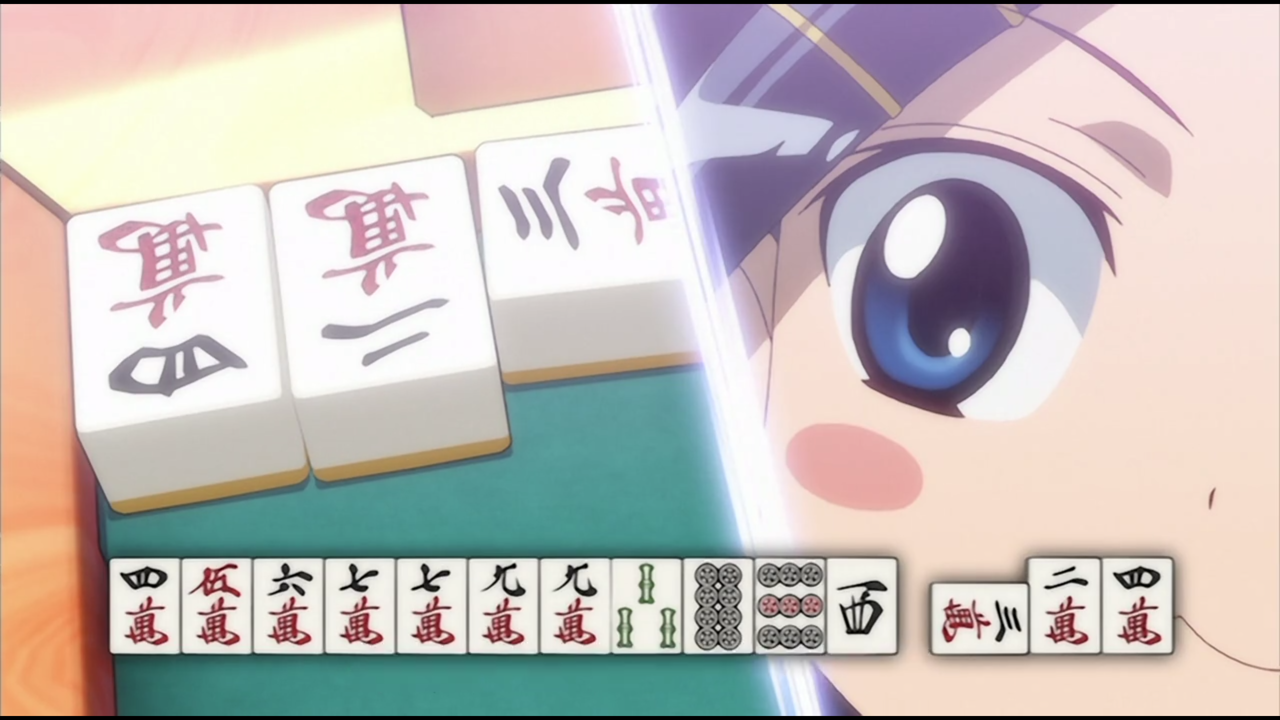
Once a fūro is formed—including via pon and kan—you can no longer discard tiles from it or swap tiles within it. In Japanese mahjong, fūro like the
1.2.2.2 Pon
Using the same hand as before:
If any other player (tācha) discards a tile of which you already hold a pair (for instance,
At this point, to enter tenpai, you have no choice but to discard
Entering tenpai after making a chī or pon call is commonly referred to as chīten or ponten, respectively.
A triplet formed by calling a tile is called an open triplet (minkō), whereas a triplet completed entirely within your hand through your own draws is called a closed triplet or concealed triplet (ankō). Logically, the terms “open sequence” and “closed sequence” could exist, but because no game mechanics differentiate them, you will rarely hear them used.
The priority of a pon (or kan) call is higher than that of a chī. If the player to the right calls chī on your tile, but the player across or to your left simultaneously calls pon (or kan), the pon (or kan) takes precedence, and the chī is canceled. Naturally, a declaration of a win by discard (ron) has the highest priority over chī, pon, and kan.
1.2.2.3 Kuikae
If you intentionally break up an already completed meld in your hand to make a chī or pon call, Japanese mahjong enforces the following restrictions:
- It is forbidden to immediately discard the exact same tile that you just used to make a call. For example, you cannot call pon on a
1s with a1s1s pair and then immediately discard the fourth1s from your hand; likewise, you cannot call chī on a4p with a5p6p tātsu and then immediately discard another4p from your hand. - If you call chī using a ryanmen tātsu, it is also forbidden to immediately discard the tile on the opposite end of that sequence (referred to as a tile on the same “suji”). For example, if you call chī on a
4p with a5p6p , you cannot immediately discard a7p .
These illegal moves are collectively known as the prohibition of kuikae.[9] When aiming for certain yaku, you must be careful not to commit a foul by violating this rule.
Since Japanese mahjong does not actively encourage making a kan call as much as Chinese mahjong does, and because kan involves the uniquely Japanese dora mechanics, we will cover it later in 1.2.4. Next, we will introduce several of the highest-frequency yaku. Before we do, however, we need to understand the overall flow of a game of Japanese mahjong so that we can properly introduce our very first yaku.
1.2.3 Yakuhai and Tanyao
The most prevalent format in Japanese mahjong is the hanchansen (“hanchan match”),[10] also called a tonnansen (“East-South match”):
- Randomly determine the first dealer (chīcha), who starts as East for the opening hand.
- The dealer position rotates counterclockwise (passing to the player’s right) after each hand, while physical seats remain fixed. The hands from East 1 (ton 1-kyoku) to East 4 (ton 4-kyoku) comprise the East round (tonba).
- The dealer position completes another full rotation from South 1 (nan 1-kyoku) to South 4 (nan 4-kyoku), comprising the South round (nanba).
The terms “East round” and “South round” mean that during the East round,
Please keep in mind that “East round” and “South round” only represent the round wind, and the dealer is always the east player. Advancing from East 4 to South 1 is called nannyū (“entering South”), where the round wind changes from
Second only in popularity to the half-game is the tonpūsen (“East-only match”), where only the East round is played.
Next, let us look at our second yaku. Regardless of the round wind,
Before announcing their points, a winning player can announce each of their achieved yaku one by one (though this is not permitted under competitive rules). For the two types of wind yaku mentioned above, players generally declare the name of the wind tile itself, namely “ton” (East), “nan” (South), “shā” (West), or “pē” (North).
For the dealer during an East round, or the south player during a South round, the two yaku above will inevitably be achieved at the same time if a triplet is formed. In this case, they stack to become 2 han, a combination known as renfōnpai (“double wind tile”). When declaring this yaku, players say “dabu-ton” (double-East) or “dabu-nan” (double-South).
On a related note, let us introduce the final type of yaku that can be achieved directly with a single triplet, which remains valid regardless of your seat wind or the round wind:
三元牌 (Dragon Triplet): Containing a triplet ofWhen declaring this yaku, the name of the tile itself is used as the yaku name: “haku” (White), “hatsu” (Green), or “chun” (Red). The hand shown at the beginning of Section 1.2.2 features this “haku.”
Seat winds, round winds, and dragon tiles are collectively referred to as yakuhai (also known as fanpai). While it is ideal to draw the tiles yourself to form a closed triplet (ankō), even if you only start with a pair, calling pon immediately secures 1 han. It remains valid even if you call chī or pon on other tiles first and wait to call your yakuhai later (atozuke), which drastically accelerates the speed of your hand. Because of its incredible utility, it has long been nicknamed the “express ticket” (tokkyūken). Yakuhai is one of the highest-frequency yaku in Japanese mahjong.
However, speaking of the highest-frequency yaku, we must mention:
断么九 [13] (All Simples): Composed entirely of suited tiles from 2 to 8, containing no 1s, 9s, or honor tiles. Worth 1 han.Yaochūhai (“yaochū tiles,” or terminals and honors) refer to 1s, 9s, and honor tiles altogether. On the other hand, numbered 1s and 9s alone are called rōtōhai, or terminals in English. When your hand lacks a pair of yakuhai, and other terminal or honor tiles are scarce or isolated (floating tiles, or ukihai), tanyao will always be by your side. As a popular saying on the Chinese version of Mahjong Soul loading screen goes: “Gōngfu zài gāo, yě pà duànyāo” (No matter how high your kung fu, you still fear tanyao). This refers to how rushing a 1-han cheap hand of tanyao nomi[14] makes it possible to win the hand before opponents who are struggling to build expensive hands.
1.2.4 The Dead Wall, Kan, and Others
1.2.4.1 The Dead Wall and Dora
In practice, not all tiles in the wall are destined to enter a player’s hand. There are exactly 7 stacks of 14 tiles that are strictly set aside and cannot be drawn through normal play; this is called the dead wall (wanpai). In contrast, the section of the wall from which players normally draw is called the live wall in English. Within the dead wall, there are 2 stacks (4 tiles) known as rinshanpai[15]—used for drawing a tile after declaring a kan, as explained below—and 5 stacks (10 tiles) of dora indicators (dora hyōjihai). Initially, only the top tile of the very first stack among these five is turned face up. As for the remaining 9 tiles, the top row is related to kan calls, and the bottom row is related to rīchi; we will introduce their functions progressively.

1.jpg)
For each dora tile contained in a winning hand, an additional 1 han is awarded. At the start of every hand, 1 type of tile (4 tiles in total) is designated as the dora, determined as follows:
- If the dora indicator is a suit tile (e.g.,
1p ), the next numerical tile of the same suit (2p ) becomes the dora. If the dora indicator is a 9, the 1 of the same suit becomes the dora. - If the dora indicator is a wind tile:
1z →2z →3z →4z →1z . - If the dora indicator is a dragon tile:
5z →6z →7z →5z .
Additionally, the akahai (red 5-man, red 5-sō, and red 5-pin, one tile each) also function as permanent dora, known as red dora (akadora). If the dora indicator happens to be a 4, the red 5 of that suit counts as two dora simultaneously.
Note that dora does not count as a yaku; having dora without a valid yaku will not allow you to declare a win. However, upon winning, you declare the number of dora alongside your yaku using the phrase “dora + number,” such as “dora yon” (four dora). Having one or two dora can also be colloquialized as “dora” or “dora-dora” respectively.
1.2.4.2 Kan
Declaring a kan is a call used to form a quad (kantsu)—four identical tiles. While making a chī or pon call functions exactly like drawing a tile, a kan does not. This is because a kan merely converts a three-tile meld into a four-tile meld (for the purpose of scoring and yaku determination, a quad is still treated as a triplet; that is to say, it does not affect the completion of yakuhai or any other triplet-based yaku). Therefore, you must draw an extra tile from the rinshanpai before making a discard. This changes your active hand size to 14 tiles during normal play, and 15 tiles when declaring a win (increasing further with subsequent quad). Just like with chī and pon, play continues with the player to your right after a kan discard.
Every time a kan is declared in a hand, an additional top-row dora indicator is turned face up. The new dora revealed this way is called kandora. If two or more of the revealed dora indicators are identical, each additional identical indicator increases the count of the corresponding dora in your hand by one. Since there are only four rinshanpai and four corresponding top-row dora indicators, a maximum of four kan can be declared in total per hand.
There are three types of kan:
- Open quad (daiminkan): If you hold three identical tiles in your hand and any other player discards the fourth, you can call “kan.” You then reveal the three tiles from your hand and take the discarded tile to form an open quad. If you make an open quad from the player across, you can turn either the second tile
( or the third tile3m3m-3m3m )( sideways (M.League rules fix this to the former method).3m3m3m-3m ) - Added open quad (shōminkan or more commonly kakan): After drawing a tile (including a rinshanpai), if you have a tile in your hand (or have just drawn it) that matches an open triplet already in your call area, you can call “kan.” You add this tile to the open triplet to convert it into an open quad. The added tile is placed sideways directly on top of the tile that was already turned sideways in the triplet, like so:
6z6z6z-6z= . - Closed quad (ankan): After drawing a tile (including a rinshanpai), if you hold four identical tiles in your hand (or have just drawn the fourth), you can call “kan.” You reveal the four tiles to form a closed quad. To distinguish it from an open quad, either the outer two tiles or the middle two tiles are placed face down (M.League rules fix this to the latter method), like so:
006m6m00 . If you have no other fūro, making closed quads still keeps your hand closed (menzen). It also counts as a concealed triplet when scoring yaku such as Three Concealed Triplets or Four Concealed Triplets.
Under general rules, the procedure for kan is as follows:
- Open quad (including added open quad): After declaring, you draw a rinshanpai and discard. The new dora is revealed immediately after that discard.
- Closed quad: The new dora is revealed immediately upon declaring.
Under competitive rules, however, the procedure is unified to follow the latter method for both types of quads.
There is a coincidental yaku associated with kan:
嶺上開花 (After a Kan / Dead Wall Draw): Winning by self-draw (tsumo) using a rinshanpai. Worth 1 han. Abbreviated as rinshan.While it is possible to win a hand relying solely on coincidental yaku, in a world without magic, building a hand around the expectation of them is completely unrealistic.
1.2.4.3 Haitei and Hōtei
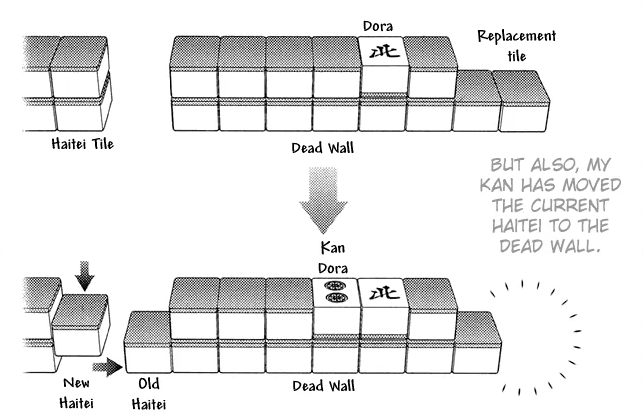
The very last drawable tile in the live wall is called the haiteihai.[16] According to the rules, each time a kan is declared, the position of the haiteihai shifts one tile forward. The original haiteihai then loses its function and is absorbed into the dead wall simply to maintain the strict 14-tile count. In fact, the history of the dead wall predates that of dora; it was originally introduced solely to increase the unpredictability of the game.
There is a coincidental yaku associated with this tile:
海底撈月 (Under the Sea): Winning by self-draw (tsumo) on the haiteihai. Worth 1 han. Abbreviated as haitei.It is strictly forbidden to declare a kan after drawing the haiteihai.
If you declare a kan on the tile immediately preceding the haiteihai, that action effectively consumes the original haiteihai by forcing it into the dead wall. If you happen to win by self-draw on the resulting rinshanpai, it does not count as haitei raoyue. In other words, rinshan and haitei cannot stack (combine) with each other.
The final discarded tile—either after drawing the haiteihai or after declaring a kan on the tile right before it—is called the hōteihai.[17] Other players are forbidden from making any chī, pon, or kan on the hōteihai. This gives rise to another coincidental yaku:
河底撈魚 (Under the River): Winning by discard (ron) on the hōteihai. Worth 1 han. Abbreviated as hōtei.1.2.5 Renchan, Exhaustive Draws, and Ending the Game
1.2.5.1 Renchan
When a hand ends and the current dealer retains their position for the next round—meaning the seat winds of all four players remain unchanged—it is called renchan (“dealer repeat”). The conditions for a renchan are as follows:
- Agari renchan (“renchan upon winning”): The dealer wins the hand and continues.
- Tenpai renchan (“renchan upon tenpai”): If the hand ends in an exhaustive draw and the dealer is in tenpai (see 1.2.5.2), they also continue.
When a renchan occurs, the number of honba increases by one. For example, during East 3, the dealer’s very first hand is called East 3, Honba 0. Their first renchan advances the game to East 3, Honba 1, and so forth. In tiles-only games without a automatic table, the dealer places a single 100 stick on the table as a visual marker for each added honba. These are called tsumibō or babō. Automatic tables display the honba count directly in the center of the table.
When any player wins a hand, if it is a win by discard (ron), the player who dealt in must pay an additional 300 points per honba. If it is a win by self-draw (tsumo), the other three players must each pay an additional 100 points per honba.
If the conditions for a renchan are not met at the end of a hand, the dealer position passes to the player to their right. In Japanese, this is referred to as oya-nagare, and non-dealers may describe this action as oya o nagasu.
1.2.5.2 Exhaustive Draws
In the case of an exhaustive draw, players in tenpai must reveal their hands and declare “tenpai,” while players not in tenpai must place their tiles face down and declare “nōten.” In reality, if you have not declared rīchi, you can intentionally declare nōten even if you are technically in tenpai, but online platforms like Tenhō and Mahjong Soul automatically force a tenpai declaration if your hand qualifies. As previously mentioned, a total of 3,000 points in nōten penalties (nōten bappu) is collected evenly from the nōten players and distributed equally among the tenpai players. Naturally, this results in the following exchanges:
- If zero players are in tenpai, no points are exchanged.
- If one player is in tenpai, the three nōten players pay 1,000 points each to that tenpai player.
- If two players are in tenpai, each of the two nōten players pays 1,500 points to one of the tenpai players.
- If three players are in tenpai, the lone nōten player pays 1,000 points to each of the three tenpai players.
- If all four players are in tenpai, no points are exchanged.
Regarding what qualifies as tenpai at an exhaustive draw, the rule states that a tenpai with no yaku (yaku-less tenpai, keishiki tenpai or simply keiten) as well as a hand whose winning tiles are completely depleted across the discards and hands (karaten or empty tenpai) both count as valid tenpai. The only exception that does not count as tenpai is when your hand is inherently impossible to win on judging strictly from the tiles held in your hand (under general rules, this only considers your concealed tiles, whereas competitive rules take fūro into account as well):
A renchan is not the only event that increases the honba; an exhaustive draw does so as well. If a round ends in an exhaustive draw, the dealer position rotates, but the honba increases by one. For example, an exhaustive draw at East 1, Honba 0 leads to East 2, Honba 1; an exhaustive draw at East 4, Honba 3 leads to South 1, Honba 4, and so forth.
1.2.5.3 Ending the Game
Finally, let us look at when a game comes to an end. Taking a hanchan as our example, the all last will be South 4. Under general rules, the match ends when any of the following conditions are met:
- If any player’s points drop below zero (hakoten) after the points are settled at the end of any hand, the game ends immediately. This is known as being bankrupt (tobi).
- The dealer in the all last (rasuoya) can also achieve a renchan. The game continues until they fail to meet the renchan conditions, at which point the game ends (or enters a West round, see below).
- However, even if they meet the renchan conditions, if the dealer is already in top (first) place at that moment, the game still ends automatically. Mirroring renchan, these are called agari yame (“stopping upon winning”) and tenpai yame (“stopping upon tenpai”).[18]
- If no player has reached 30,000 points at the end of the all last, the game enters the West round (shānyū), where the round wind becomes
3z . Once in the West round, the match ends instantly as a sudden-death format the moment anyone exceeds 30,000 points.- While Tenhō and Mahjong Soul max out at West 4 and do not allow entering a North round, traditional rules may feature a North round, or even progress to a “returning East round” (kaeriton) if conditions remain unmet at the end of North 4.
Under competitive rules, there is no bankruptcy (play continues even with negative points), no West round, and neither agari yame nor tenpai yame exists (as long as the dealer meets the conditions to continue, they are forced to do so).
Finally, let us do a quick puzzle: How many han is this?
South 1, South Player
Dead wall: 00004p1z000000 2m2m3m4m5m1p2p3p4p0p 2z2z2z-2z= 3p Ron
(Click to expand answer)
8 han (Double-South, 6 dora)
Literally “character; role.” ↩︎
Written in kanji as 翻 or 飜. Functionally, it refers to the number of score doublings, though in modern Japanese mahjong, this strict exponential doubling is capped by the mangan system. ↩︎
The higher the value of the hand, the higher the “base points” (kihonten). The exact algorithm will be detailed in the section on scoring. Actual payments are rounded up to the nearest hundred, meaning a non-dealer’s payment is not always exactly half of the dealer’s payment. ↩︎
Literally “clear in front of the gate.” ↩︎
Literally “calling.” ↩︎
Literally “tile set exposure.” ↩︎
Literally “eating.” ↩︎
Literally “setting up.” ↩︎
Literally “eating and swapping.” ↩︎
“Han” (半) literally means “half”; “chan” literally means “dealer position” and has been shifted here to mean “a full game.” Playing through the East and South rounds is called a “half-game” because it is based on the traditional full game (īchan) consisting of East, South, West, and North rounds, a format that is no longer popular in Japan. ↩︎
The translation of yaku names is mainly based on the European Mahjong Association’s version: http://mahjong-europe.org/portal/images/docs/Riichi-Summary-and-Yaku-Sheet2025.pdf ↩︎
Completing triplets of all three types results in the “Big Three Dragons,” which will not be discussed for now. ↩︎
Tan means “to eliminate,” and yao is short for yaochū. The Japanese yaku names in this tutorial follow standard convention by using their common, everyday terms. For instance, while All Simples has the full formal name tanyaochū, it is rarely used in actual play and is therefore omitted here. ↩︎
Nomi means “only.” Tanyao nomi means a hand with “only tanyao and no other yaku.” ↩︎
Literally “tiles on top of the mountain peak.” ↩︎
Literally “tile at the bottom of the sea.” ↩︎
Literally “tile at the bottom of the river.” ↩︎
These terms originally meant that the dealer could “voluntarily choose” whether to end the game, but in platforms like Tenhō and Mahjong Soul, they function as described here. ↩︎