
1.1 Basic Mechanics
Rīchi mahjong is a game with a significant luck component; yet, over hundreds of games, skill differences become readily apparent. This tutorial follows the general Japanese mahjong rules that became more settled in the early 21st century, particularly after the rise of online mahjong. Competitive rules, as represented by M.League (Mリーグ), differ from general rules in numerous details; these differences will be noted as appropriate.
Japanese mahjong terminology, like the game itself, was transmitted from China. The pronunciations of many Sino-Japanese terms often resemble older Beijing Mandarin forms. Moreover, many terms and their translations have multiple synonymous names. I will endeavor to mention as many as practicable, but omissions are inevitable; please do not be surprised if you encounter variants in other materials.
1.1.1 Mahjong Tiles
Standard Japanese mahjong uses 136 tiles (pai or hai): 34 tile types, four copies each. The “flower tiles” (Chinese: huāpái; Japanese: fapai or hanahai), common in parts of southern China, are usually included in commercial Japanese sets but are not used in general rules.
Known as character tiles in English. Man has an alternative reading, wan. These characters are literally from “ten thousand” to “ninety thousand,” but they actually just represent the numbers 1 through 9.
Known as dot tiles or circle tiles in English.
Known as bamboo tiles in English. Many references annotate sansō, but what I have actually heard is often sanzō.
These 27 tile types are collectively called suited tiles or numbered tiles (shūpai or sūpai). In the most widely used modern Japanese rules, one 5-man, one 5-pin, and one 5-sō are replaced by red tiles (akahai), as shown below in the image. They are often marked with a small dot for accessibility
There are also 7 types of honor tiles (tsūpai or jihai[1]), shown below.
Ton (East), nan (South), shā (West), and pē (North) are collectively wind tiles (fonpai or kazehai), while haku (White), hatsu[2] (Green), and chun[3] (Red) are collectively dragon tiles (sangenpai[4]).
Tile glyphs in this blog are rendered with the I.Mahjong font, without color. Here are photos of real, colored mahjong tiles.
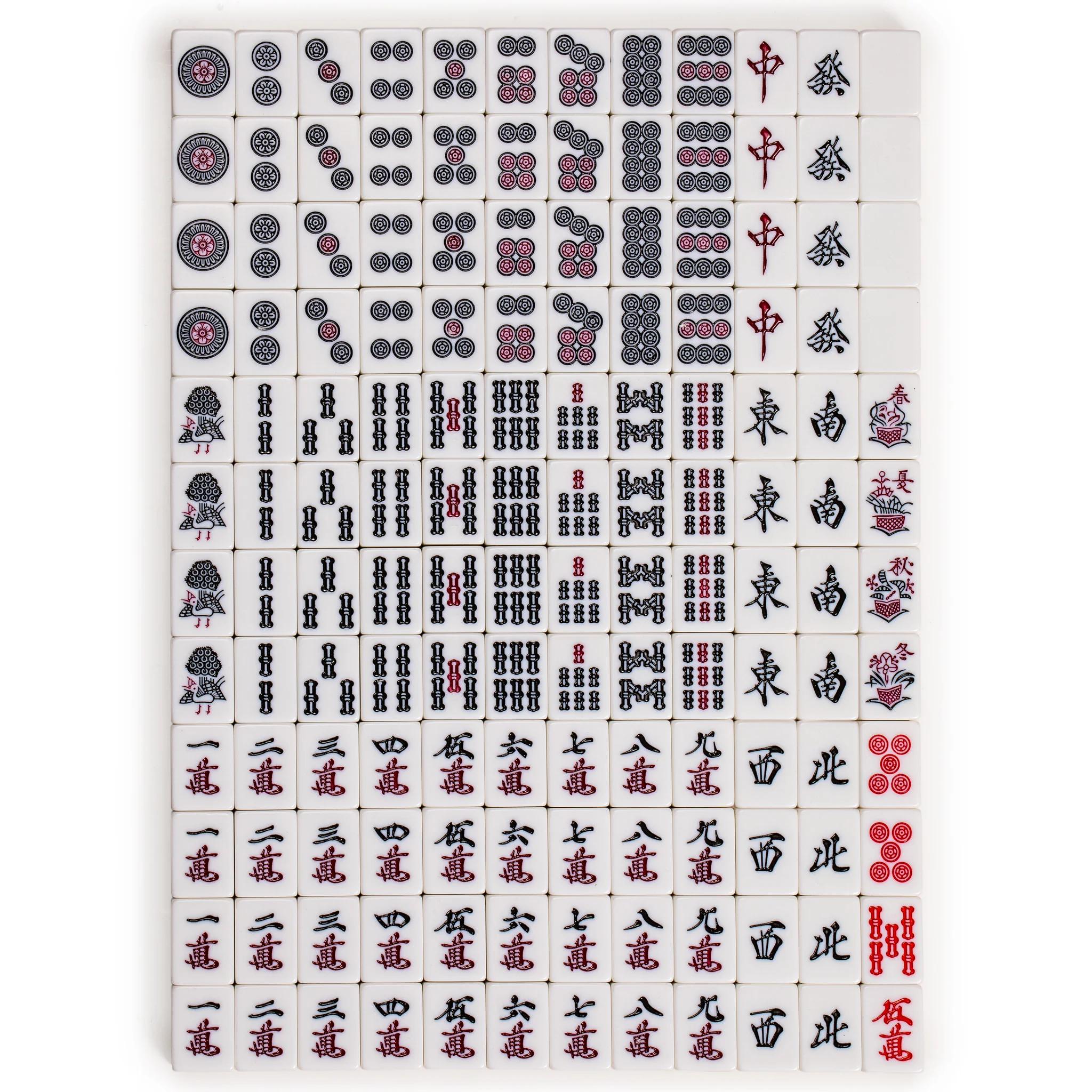
In Japanese mahjong sets, green is often very dark and can look black. The dark strokes on bamboo tiles and on
1.1.2 How a Hand Proceeds
Let us start after the initial deal (haipai) is complete. At that point, each player has 13 tiles in hand, e.g.
After that, players take turns in a draw-discard cycle:
- Draw (tsumo): first, draw the next tile from the “wall” (yama[5]).
- Discard (dahai): then choose one tile from your hand and discard it.
↓ Discard
Your discard pile is called the hō or kawa (“river”) in Japanese.
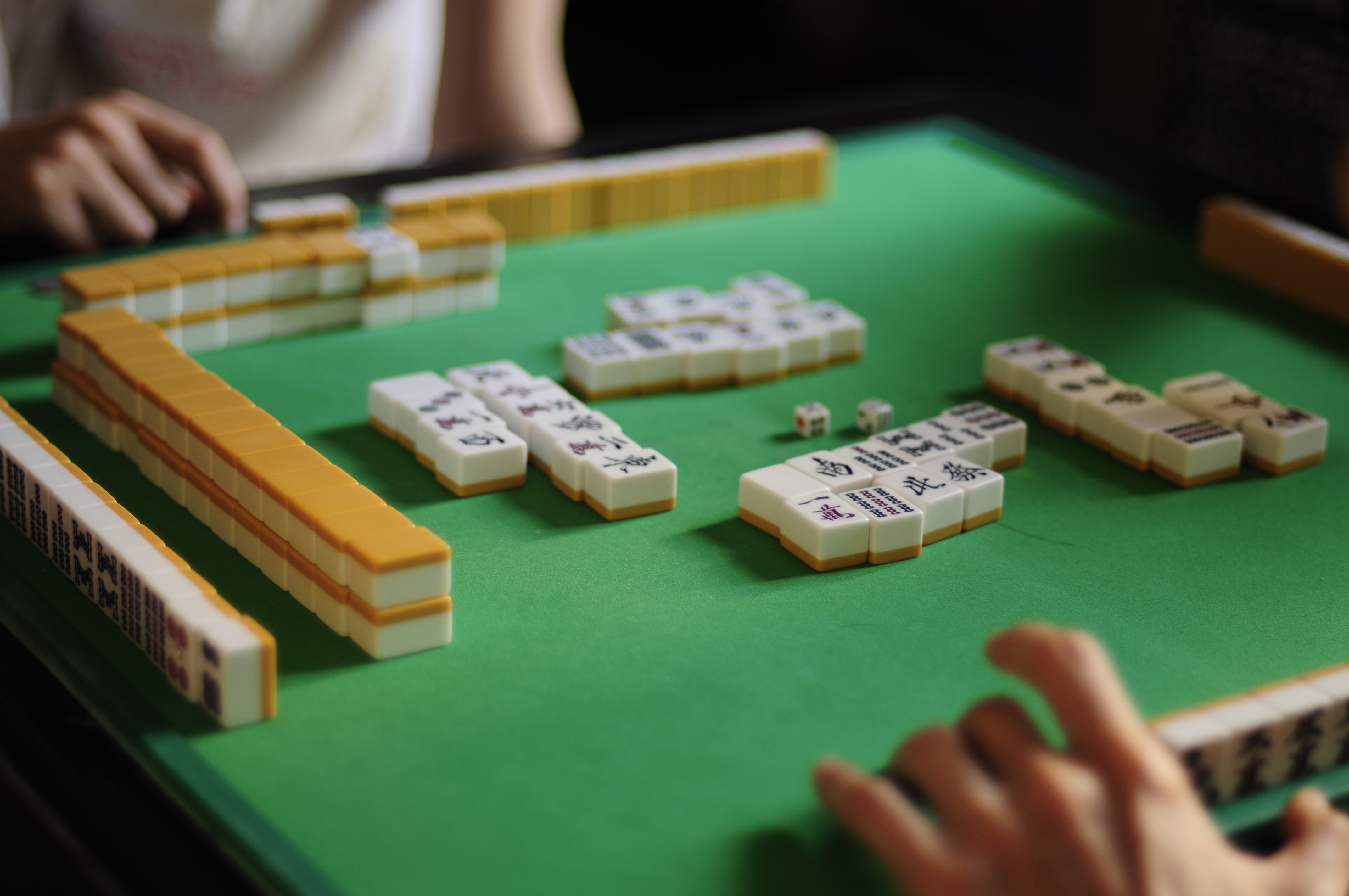

Mahjong is a four-player game. Four players sit around a square table and take turns counter-clockwise.
In Japanese, the other three players at the table are called tācha (“the other players”). The player to your left is your kamicha (“previous player”); after they play, it is your turn. After your turn, it passes to your right-side shimocha (“next player”), and the player across from you is called toimen (“opposite”).
In each hand, one player is the dealer (oya). The other players are non-dealers (ko). In absolute seat terms, the dealer is the east player (toncha); moving counter-clockwise around the table, to their right is the south player (nancha), then the west player (shācha), and the north player (pēcha)—regardless of the actual compass directions.
If any player wins (hōra or agari), that hand (kyoku) ends immediately. Scores are settled, then all tiles are reshuffled for the next hand. Rules about hands will be discussed later; for now, let us first see how to win.
1.1.3 Winning and Tenpai
1.1.3.1 Winning Hand
Three identical tiles form a triplet (kōtsu):
Three consecutive number tiles in the same suit form a sequence (shuntsu):
Two identical tiles form a pair (toitsu):
Triplets and sequences are collectively called melds (mentsu). The basic goal in mahjong is a 14-tile winning shape of 4 melds + 1 pair, such as:
This is often called four melds and the eyes. The “eyes” (jantō, commonly atama “head”) is simply the pair inside a completed winning hand.
1.1.3.2 Tenpai
As described above, each player starts with a 13-tile hand. On your turn, you draw a 14th tile and then make a discard to return your hand to 13 tiles. Eventually, a player will complete a 14-tile winning hand upon drawing a tile and declare a win. When your 13-tile hand is just one tile away from winning, this state is called tenpai[6]:
This hand wins on either
Wait classification matters later for fu calculation. This example is still categorized as ryanmen: if the winning tile is
1.1.3.3 Declaring a Win
Once you are in tenpai, you can win not only by drawing your winning tile yourself (tsumohō or tsumoagari) but also by winning on another player’s discard (ronhō or ron’agari). In the case above, if you draw
In Japanese mahjong, completing a winning shape is not enough by itself. You also need at least one valid yaku and must not violate furiten rules. Still, the core is the hand shape, and this tutorial will guide you through those additional requirements naturally.
1.1.4 Wait Patterns
Within the standard four-melds-one-pair structure, besides ryanmen waits, there are four other wait (machi) patterns:
If your hand has three complete melds and one pair, plus two same-suit tiles with one gap between them, that is a kanchan[7] wait:
1s2s3s1p3p1m2m3m3m3m9m9m9m Wait on “kan-2p ”Can you spot which tiles are serving as the eyes here? A ryanmen wait has two winning tile types, while a kanchan wait has only one, so it is generally harder to win with.
If the final incomplete shape is 1-2 or 8-9, that is a penchan[8] wait:
8s9s2p3p3p3p4p1z1z1z2z2z2z Wait on “pen-7s ”The tiles are sorted by rank. In dot tiles, this is sequence
2p3p4p plus eyes3p3p .If the hand already has three melds and the remainder is two pairs, waiting on either tile to make a triplet is a shanpon[9] wait:
5p0p3s4s0s6m7m7m8m8m9m1z1z Wait on “5p -1z shanpon”The character tiles are actually two sequences.
If four melds are complete and one lone tile remains, waiting for its match to form the pair is a tanki[10] wait:
1s3s3s3s4s4s4s6s6s6s8s8s8s Wait on “1s tanki”Actually, this example is not purely a tanki wait. This hand also waits on
2s ,3s3s as the eyes, resulting in a kanchan wait on2s .
If we replace 1s with 2s in the last example:2s3s3s3s4s4s4s6s6s6s8s8s8s
this becomes a very wide wait. Can you find all winning tiles?(Click to expand answer)
First, treat
However, the
Although shanpon waits are apparently “double” sided, they are treated separately in the five basic wait patterns. From a tile-efficiency perspective, shanpon is harder to win than ryanmen (or the real “double-sided” wait). Each tile type has only four copies in total. Compare
Literally “character tiles.” ↩︎
Literally “departure; emit; get rich.” ↩︎
Literally “center; middle; inside; hit (a target).” ↩︎
Literally “trio tiles.” ↩︎
Literally “hill; mountain.” ↩︎
Literally “listen to tiles.” ↩︎
Literally “inlay tile.” ↩︎
Literally “side tiles.” ↩︎
Literally “dual touch.” ↩︎
Literally “(to fight) single-handedly on horseback.” ↩︎